
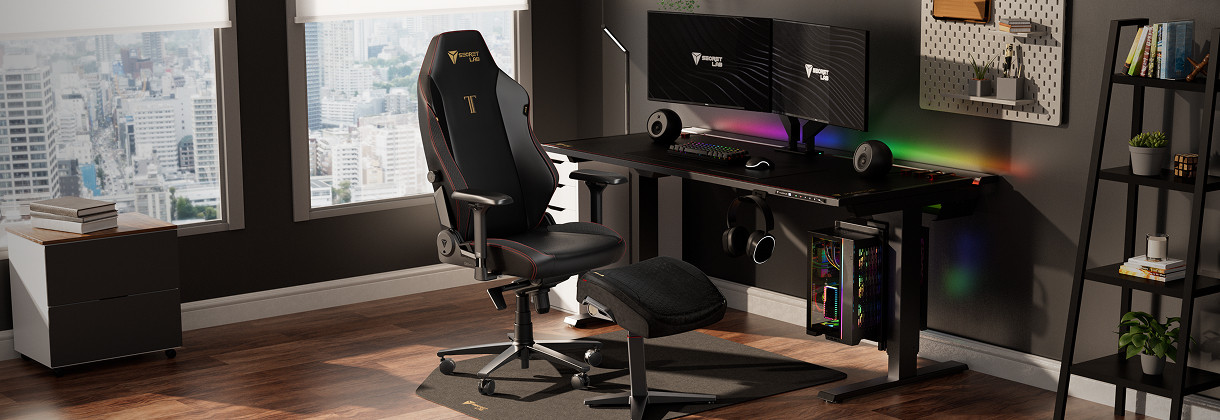

An ergonomic chair is designed to support the body comfortably through long hours of sitting. It uses adjustable features, targeted support, and anthropometric measurements to help you find a personalized fit and reduce fatigue through natural movement.
What to look for in an ergonomic chair
The best ergonomic chair is one that fits your body and supports you as you move. Look for these key features:
-
Full-height backrest
-
Dedicated lumbar support
-
Seat depth
-
4D armrests
-
Recline with multi-tilt or synchronous tilt
- Independent ergonomics certification
How an ergonomic chair supports you
A well-designed ergonomic chair supports your back, arms, and legs, while also encouraging natural movement throughout the day. It reduces how hard your muscles have to work to support you when sitting and distributes pressure evenly.
Full-height backrest supports your entire back

Many office chairs use mid-back designs that stop halfway up the spine. These can work well for shorter periods of focused, upright sitting, but provide less support as you lean back and change posture.
A full-height backrest supports more of the spine, from the lumbar region through the thoracic and cervical regions. When properly shaped to the body, its larger contact area can also distribute pressure across a greater surface area for greater comfort.
This becomes increasingly important over long periods of sitting. You are unlikely to remain perfectly upright all day. You will lean back, recline, shift position, and change posture.
Secretlab TITAN Evo and ATLAS™ feature full-height backrests designed to support these natural movements, so you remain supported across a wider range of sitting positions.
Dedicated lumbar support maintains your spine’s natural S-shape

Your spine naturally forms an S-shape, comprising four curves: cervical, thoracic, lumbar, and sacral. The lumbar spine bears much of the weight of your upper body, making it particularly important to support when seated.
When you slouch, your pelvis rotates backward and your natural lumbar curve flattens. This can cause the thoracic spine to round and the head to shift forward, increasing strain on the muscles that support your posture.
Dedicated lumbar support helps maintain the natural curve of your lower back and reduce the muscular effort required to hold you upright. For the best fit, look for lumbar support that can be adjusted to match your body.
Secretlab TITAN Evo features dynamic lumbar support with independent height and depth adjustments. A Y-shaped lattice of living hinges flexes with your back as you move, providing continuous support across different postures.
Secretlab ATLAS™ uses a hybrid spring-and-foam lumbar structure that microflexes to your body shape and movements for responsive support.
Adjustable seat depth reduces pressure points

Seat depth determines how well the seat pan fits the length of your thighs.
Taller people generally require a deeper seat to support more of the thighs and distribute pressure across a larger area. Shorter people need a shallower seat to avoid excessive pressure behind the knees while maintaining contact with the backrest.
An adjustable seat depth accommodates a wider range of body sizes and helps you find a position where both your legs and back are properly supported.
Secretlab ATLAS™ offers seat depth adjustment from 46 to 52cm, allowing you to tailor the seat to your body.
Adjustable armrests support your forearms, shoulders, and neck

Adjustable armrests take weight off these muscles while allowing you to position your arms naturally for different tasks and postures.
Look for adjustments that include:
-
Height: Matches your seated elbow height and helps keep your shoulders relaxed.
-
Front-to-back: Accommodates different body sizes, postures, and desk setups.
-
Rotation: Supports different arm positions as you work, type, or recline.
-
Side-to-side: Adjusts armrest spacing to suit different shoulder widths and builds.
Secretlab TITAN Evo features 4D armrests with all four adjustments, while Secretlab ATLAS™ offers front-to-back, height, and rotational adjustment.
Recline with multi-tilt or synchronous tilt encourages movement

An ergonomic chair should support movement, not lock you into a single “correct” posture. Reclining lets you regularly change position and redistribute the loads acting on your body.
Different recline mechanisms provide different types of movement.
Multi-tilt mechanisms allow the backrest recline angle to be adjusted independently of the seat base. This gives you greater control over your sitting angle and enables a deeper recline. Secretlab TITAN Evo uses a multi-tilt mechanism for greater freedom across working, gaming, and resting positions.
Synchronous tilt mechanisms move the backrest and seat together at a coordinated ratio. Secretlab ATLAS™ uses a 2:1 synchronous tilt, opening the angle between your torso and thighs while making it easier to keep your feet planted as you lean back. This makes it particularly suited to focused, task-oriented sitting.
Independent ergonomics certifications
Many chairs claim to be ergonomic. But few are actually certified. Ergonomic chairs like Secretlab TITAN Evo and Secretlab ATLAS™ have been tested and validated by an independent Ergonomics Advisory Board.
They are also certified by United States Ergonomics to provide measurable ergonomic benefits to the user by improving comfort and fit and minimizing risk factors that may cause injuries. Both chairs are subjected to rigorous, objective tests in adherence to guidelines established by the International Ergonomics Association. This ensures they meet or exceed standards derived from published literature and principles of ergonomics, biomechanics, and human factors.
Ergonomic chair vs. standard chair: What's the difference?
The key differences between an ergonomic chair and a standard chair lie in the degree of adjustability and level of support. Standard chairs are often designed around a single, fixed posture and do not take into account the full range of natural movement.
| Ergonomic chair | Standard chair | |
| Adjustability | Seat height, seat depth, armrests (up to 4D), lumbar support, tilt tension, and recline angle | Often limited to seat height |
| Lumbar support | Dedicated and adjustable to match the curve of your spine | None |
| Backrest | Full-height backrest. Supports a wide range of postures. | Mid-back. Supports a single, fixed posture. |
| Materials | High-density foam and technical fabric and leatherette | Basic foam and fabric |
| Typical lifespan | 8-12+ years with replaceable parts | 2-5 years |
| Warranty | 3-5+ years | 1 year |
| Price | $300-$1,500+ | $50-$150 |
Do I need an ergonomic chair?

If you spend several hours a day sitting, an ergonomic chair is a worthwhile investment. The right chair fits your body, supports you across different postures, and encourages you to move throughout the day.
By supporting your spine’s natural curvature and your arms’ weight, a good chair reduces how hard your muscles have to work to hold you up. A seat that fits you well also distributes your weight more effectively and minimizes pressure peaks, which prevents stress from building up.
Whether you’re working, gaming, or simply spending more time at your desk, a well-designed chair is crucial to keeping you comfortable for long hours.
Reviewed by the Secretlab Product & Ergonomics Team
Frequently asked questions
Q: What does an ergonomic chair do?
A: An ergonomic chair supports your spine’s natural curves, carries the weight of your arms, distributes pressure across a larger area, and keeps you supported as you change posture — so your muscles work less and you feel less fatigued over long hours.
Q: What does it mean when a chair is ergonomic?
A: Ergonomics is the study of designing and arranging things so people can interact safely and efficiently. An ergonomic chair can be fitted to you, instead of forcing you to adapt to it. In practice, that means adjustability, targeted support, and dimensions based on anthropometric data.
Q: What is the difference between an ergonomic chair and a normal chair?
A: Adjustability and fit. A standard chair offers one sitting position. An ergonomic chair adjusts to your body and supports multiple postures.
Q: Are ergonomic chairs worth it?
A: Yes, especially if you’re sitting for several hours a day. The lack of proper support can contribute to back pain and other discomfort over the months and years. A good ergonomic chair helps reduce the risk of injury with a personalized fit and adjustments. It also encourages natural movement and posture changes, which helps to prevent pressure from peaking in a single area.
Q: Can a gaming chair be ergonomic?
A: Yes. A gaming chair with adjustable lumbar support, seat fit, and a full-height backrest can be ergonomic. Secretlab TITAN Evo has been tested by leading ergonomics experts and is certified by United States Ergonomics.
Q: How do I know if an ergonomic chair fits me?
A: You can check how the chair fits in three areas:
-
Seat height: Your feet rest flat with knees at roughly 90°.
-
Seat depth: You can fit 2 to 3 fingers between the seat edge and the back of your knees.
-
Size: The size matches your height and weight.